


As Oxford Street prepared to go traffic-free for the first time in its history on the 26th October 2026, our teams worked hard behind the scenes to ensure appropriate hostile vehicle mitigation was put in place ready to protect the London public on the first day of its pedestrianisation.
Being involved in this historic moment for one London’s most famous streets was a real privilege for everyone at Crowdguard. Let’s take a look at how our Plan – Provide – Protect methodology informed our approach to this project.
Plan – preparation for Oxford Street closure begins months in advance
Planning Involved Multiple Stakeholders. Creating more space for people in one of London’s busiest destinations brought its own considerations as we needed to account for high pedestrian footfall, accessibility and the operational requirements of a busy retail environment, while ensuring that protective security measures remained proportionate and unobtrusive.
Working alongside Transport for London (TfL), we provided specialist Hostile Vehicle Mitigation expertise to help shape the scheme. Our approach considered the vehicle-related risks, the need to maintain pedestrian permeability and the importance of preserving authorised access for emergency and essential vehicles.
With the historic traffic-free opening scheduled for 26 October 2026, we also had to plan around a tight programme of road closures, coordinating with project partners to ensure the work could be delivered within the available window.
Provide – a combination of HVM assets for a dynamic solution
Working alongside FM Conway, our teams deployed a combination of three impact-tested and certified HVM systems, selected to meet the different demands of Oxford Street’s new pedestrianised environment.
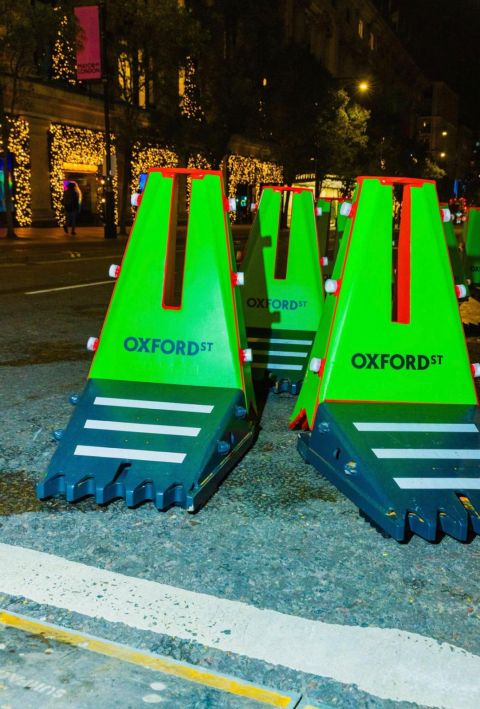
We installed 155 ARMIS GO units, impact-tested and certified to ISO 22343-1:2023. These were chosen for their fully pedestrian-permeable design, allowing shoppers, wheelchair users and other visitors to move freely through the street. The units were finished in a branded green with the recognisable Oxford Street logo, integrating the HVM measures into the street’s new identity rather than detracting from it.
ARMIS ONE, 16 number impact-tested and certified to ISO 22343-1, was selected for its integrated fold-down mechanism, providing the flexibility to accommodate authorised vehicle access where needed, without compromising pedestrian accessibility during normal operation.
We also deployed 14 number ATG Surface Guard, an IWA 14-1:2013 impact-tested system. This modular, surface-mounted solution can accommodate the varied features of an established city-centre streetscape. Its pedestrian-permeable design and flexible configuration made it a practical addition to the scheme.
With only a short window between the road closures and Oxford Street reopening the following day, our teams worked overnight to install the assets. Coordinating closely with FM Conway, we completed the deployment in time for the street’s first traffic-free day.


Protect – going beyond supplying HVM products
Our responsibility didn’t end with simply supplying HVM equipment. Ensuring assets are installed correctly, in accordance with their independently tested configuration, is fundamental to the protection it is designed to provide.
For Oxford Street, our trained and experienced operatives followed strict quality assurance procedures, checking the installation against the agreed specification and manufacturer requirements. Documented checks and sign-off formed part of our due diligence process, providing assurance that the deployed systems met the required standards.
This commitment to installed-as-tested integrity ensures that the performance of the HVM measures is supported by the appropriate evidence, competent installation and professional oversight.
In addition to Oxford Street now being a traffic-free zone, other initiatives will be taking place to make this location a more accessible, greener, and more enjoyable shopping experience for all. By Spring 2027, 50 new trees will be planted, as well as over 100 new seats installed. It’s fantastic to see Oxford Street beginning this next chapter, and we are proud to have played a part in such a significant London project, especially when it has helped to create a public space that remains open, welcoming and enjoyable.
Planning a permanent HVM scheme? Get in touch with our team at info@crowdguard.co.uk.