

Key facts
PLAN
Working with the University of Huddersfield, we developed a risk-led, proportionate approach informed by a full Threat, Vulnerability and Risk Assessment (TVRA) and Vehicle Dynamics Assessment (VDA), undertaken by Pete Dalton of PAD Consultancy. Alongside the security requirements, we considered pedestrian permeability, accessibility, campus operations and the surrounding environment to ensure the proposed scheme was practical and appropriate.
PROVIDE
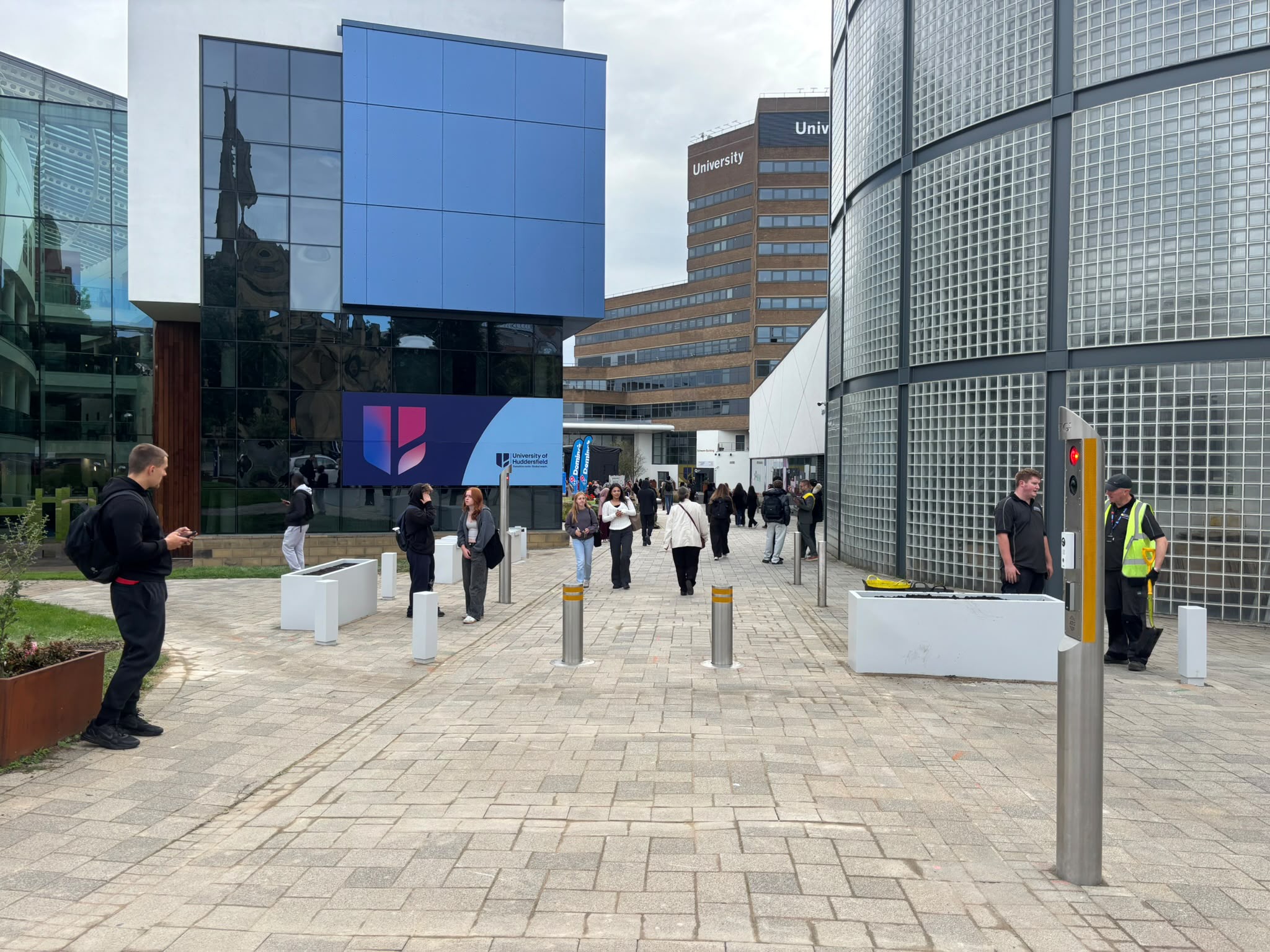
Drawing on our extensive HVM portfolio, we specified solutions suited to the assessed risks, operational needs and campus environment. These included impact-rated Unafor Core systems integrated into benches and planters, alongside ATG Access bollards for controlled vehicle access, balancing protection with accessibility and design.
PROTECT
Crowdguard coordinated the installation alongside the University and civil engineering contractor NWSB, managing the project to minimise disruption, maintain campus access and meet tight timescales ahead of student welcome week. Quality assurance, compliance with the agreed specification, tested configurations and manufacturer guidance, together with appropriate sign-off and certification, were key considerations throughout delivery.

How do you introduce permanent hostile vehicle mitigation into a busy university campus without compromising accessibility, pedestrian movement or the welcoming character of the space?
This was a key consideration for the University of Huddersfield as it worked with Crowdguard to deliver a permanent HVM scheme ahead of its September 2026 student welcome week.
Combining specialist risk assessment, shallow-mount impact-rated protection, integrated vehicle access and carefully considered landscaping, the project demonstrates how campus security can be designed around the people and places it is intended to protect.


Our Approach to Permanent HVM for the University
We worked in close partnership with the University of Huddersfield to develop a their HVM scheme that supports campus safety without compromising accessibility, pedestrian movement or the welcoming character of the university environment.
The initial assessment was led by Pete Dalton of PAD Consultancy and Crowdguard General Manager Cameron Ainscough, combining specialist HVM expertise with professional site assessments and AI-assisted research.
A controlled AI-supported research process helped gather and organise relevant information from approved sources. Crucially, this supported rather than replaced professional judgement.
Pete and Cameron then undertook detailed site surveys and assessments, using NPSA Vehicle Dynamics Assessment (VDA) methodology to inform proportionate recommendations based on the University’s specific requirements.
Pete and Cameron then carried out detailed in-person site surveys and physical assessments to validate the findings and understand the campus’s particular vulnerabilities and operational requirements.
Using the NPSA’s Vehicle Dynamics Assessment (VDA) methodology and tools, they developed a clearer understanding of the vehicle-related risks and the measures that could reasonably be considered. This informed a professional assessment report and proportionate HVM recommendations, ensuring the proposed scheme was based on evidence, rather than a one-size-fits-all approach.
One of the main considerations was maintaining pedestrian permeability. With thousands of students, staff and visitors moving around campus, particularly during busy periods, it was essential that the protective measures did not create unnecessary restrictions or accessibility issues.
There were also practical challenges associated with uncertainty around existing underground cables, utilities and service networks. This made shallow-mount HVM an appropriate option, helping to minimise intrusive groundwork while accommodating the site’s infrastructure.
Throughout the project, extensive planning, meetings and coordination between Crowdguard and University colleagues ensured that the proposed measures aligned with the University’s requirements and the demanding installation programme.
The Solution
The HVM project was developed across two locations, with Phase 1 focused on Queensgate Plaza and Phase 2 covering Rifle Street.
Based on the findings of our site assessments and Vehicle Dynamics Assessment (VDA), we specified an integrated solution combining impact-rated HVM, controlled vehicle access and attractive, multipurpose street furniture.
The scheme included Unafor Qube benches and planters, ATG Access drop-down bollards, additional Marshalls products (specification to be confirmed) and Axis Communications intercoms.
We worked closely with civil engineering contractor NWSB, who carried out the groundworks and construction work required for the installation, coordinating with our team to ensure the scheme was installed as specified and in line with the University’s requirements.
The Unafor Core system was particularly well suited to the campus environment. Its shallow-mount design addressed the challenges presented by existing underground services, while its flexible street furniture options enabled certified HVM protection to be integrated into the landscape.
The benches and planters provided an attractive, multipurpose alternative to more conventional security infrastructure, demonstrating how HVM can complement surrounding buildings and public spaces while offering practical benefits for everyday campus life.
The University also embraced the opportunity to bring additional greenery into the scheme. Its volunteer gardening group, supported by the Sustainability and Grounds teams, planted colourful shrubs and bedding plants in the Unafor Qube planters.
This collaborative finishing touch helped create a softer, more natural appearance, demonstrating how security infrastructure can contribute positively to the look and feel of a busy university campus.
The combination of protective measures, integrated access arrangements and landscaping delivered a solution designed around both security requirements and everyday campus life.
The Outcome
Through close collaboration, careful planning and a coordinated installation programme, Crowdguard successfully delivered the project ahead of the September 2026 student welcome week.
Despite the challenges of working around existing underground infrastructure and within an active university environment, the team delivered a permanent HVM scheme that balances protective performance with accessibility, practicality and design.
The completed installation provides a welcoming addition to the campus, with contemporary street furniture and landscaping helping the protective measures blend naturally into their surroundings.
For the University of Huddersfield, the investment represents a proactive step in its wider approach to campus safety and preparedness ahead of Martyn’s Law.
For Crowdguard, the project demonstrates the value of specialist HVM expertise, evidence-led planning and genuine collaboration in delivering solutions that are appropriate to the environment they protect.